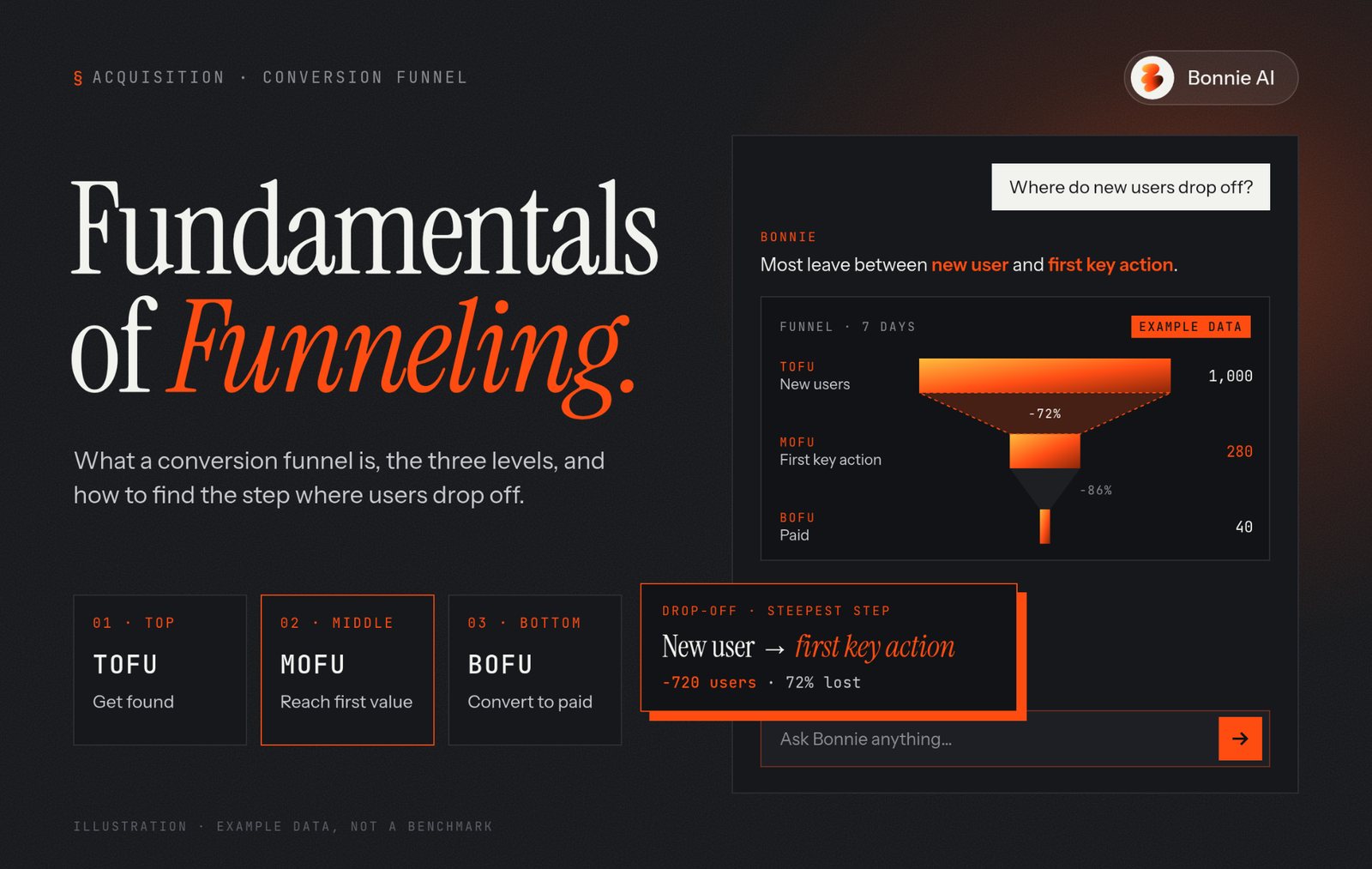
If you've heard the term funneling but aren't sure what it really means, this post is for you. A conversion funnel is the path people take from first hearing about your product to a key action, like signing up or buying. Funneling means mapping those steps and measuring how many people drop off between them.
Spotting where people drop off is the easy part. Working out why is harder, and the answer rarely sits in one tool. It is very possible that part of it lives in your analytics, and part of it in your revenue data. That's a big part of why we built Bonnie: it reads all your tools and metrics together and helps you work out what to try next.
First, let’s start with the basics.
What is a conversion funnel?
A conversion funnel is the path from first awareness of your product to a key action, such as a signup or a purchase. Funneling means lining up those steps and measuring drop-off between them. Most teams split the path into TOFU, MOFU and BOFU — top, middle and bottom of the funnel — and give each level its own job and metric.
In product analytics, funnel analysis counts how many users complete a defined sequence of events, in order, usually inside a time window, and shows where they drop off. A common product conversion funnel is first open, then signup, then a first key action, then a purchase.
Why use funnel analysis?
Teams use a conversion funnel to find where a known path leaks, to decide which step to fix first, and to give each stage a job and a metric.
When you read funnel drop-off, look at it two ways. The absolute drop shows where you lose the most people. The relative rate, i.e. conversion compared with the previous step, shows which steps hit overall conversion hardest, and the step with the lowest relative rate is usually the biggest opportunity.
Use a funnel when you already know the path and want the counts. If you are still discovering what people do, that is a path or journey analysis, not a funnel. Funnel analysis is also not cohort analysis: a funnel measures an ordered sequence inside a window; a cohort tracks whether a group of users comes back over time.
When you measure a conversion funnel, keep the setup honest:
- Name the steps, in order, and keep the list short.
- Set a conversion window. Users who finish after it count as drop-off.
- Decide whether users must enter at the first step (a closed funnel) or can enter later (an open funnel).
- Count unique users unless you have a reason to count events or sessions instead.
- Then segment by device, source or cohort so one blended rate does not hide the leak.
What are the different levels of a conversion funnel?
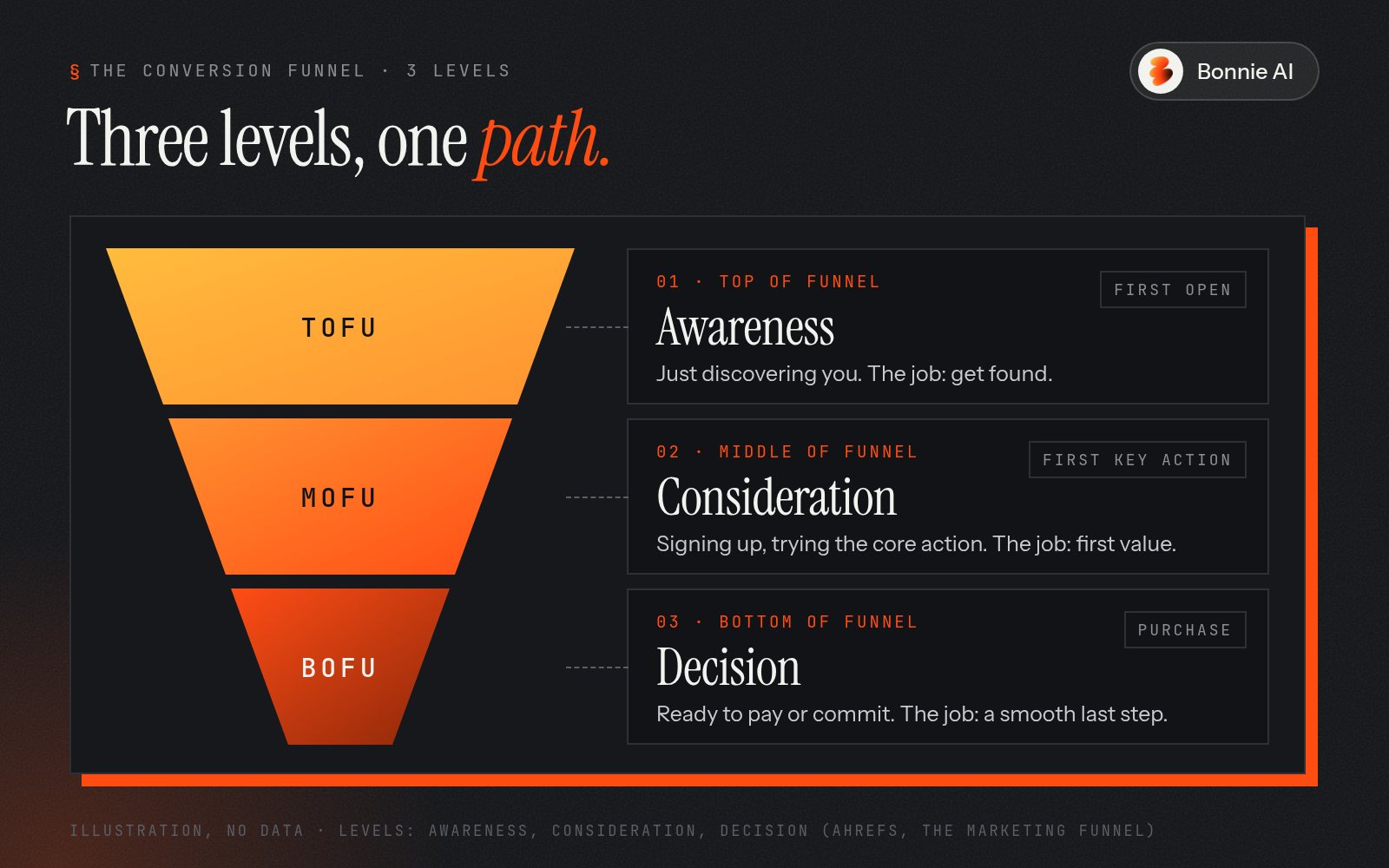
Most marketing and growth teams describe three marketing funnel stages: top of funnel (TOFU), middle of funnel (MOFU) and bottom of funnel (BOFU). Some guides map the same three levels onto AIDA instead: awareness at the top, interest in the middle, desire and action at the bottom. These funnels may be assigned different names by different companies but they primarily have the same job.
All three levels run at the same time. It is important to note that a level isn't a phase you switch on; it describes where a person is in their journey, and what your job is with them there.
| Level | Where the person is | Your job at this level | Example metric | Common mistake |
|---|---|---|---|---|
| TOFU | Just discovering you | Get the attention of as many of the right people as possible | 1,000 new users in a week | Judging awareness only on purchases |
| MOFU | Comparing, signing up, trying the core action | Show them you're the right fit and get them to first value | 280 of those 1,000 complete a first key action in 7 days | Treating signup as activation, or adding optional steps |
| BOFU | Ready to pay or commit | Turn ready buyers into customers, with as little friction as possible | 40 of those 280 start a paid plan | Starting the funnel at purchase, so you miss everyone who never reached the paywall |
What is top of funnel (TOFU)?
TOFU is the awareness stage: getting people to your pages. Your job is to get the attention of as many of the right people as possible, not to close a sale on first contact. Only a handful will reach the bottom, so go wide.
TOFU examples:
- Short-form videos on Instagram Reels or TikTok
- Search-optimised blog posts
- Creator or influencer posts
- Paid social ads
- Your app store listing showing up in store search
What is middle of funnel (MOFU)?
MOFU is the consideration stage. People have noticed you and are deciding whether your product is the right fit. Your job is to give them a clear path to first value.
For an app, this is often the onboarding funnel: first open, then signup, then a first key action. Keep the path short and set a conversion window.
Example metric: the share of new users who complete that first key action inside a stated window.
What is bottom of funnel (BOFU)?
BOFU is the decision stage. People here are choosing whether to buy, subscribe, start a trial or otherwise commit.
The people who reach the bottom are your hot leads: they are ready to convert. These are the people who are willing to give you their money. There are far fewer of them than at the top, and each one is worth more, so they deserve extra marketing effort and budget. This can be follow-ups, reminders, retargeting ads, a direct message, rather than the broad messaging you use to get attention.
Remove friction on the last steps and measure them as their own path: paywall viewed or checkout started, then purchase or subscribe.
Example metric: trial-to-paid, or purchase from the paywall — 40 of the 280 activated users in the table.
Other types of funnels
TOFU, MOFU and BOFU describe the levels of any funnel. The type of funnel is how you move people through those levels. Most funnels draw on one or more of these moves, in whatever order fits:
- Give something free. A guide, a template, a trial, a free session. Something useful before you ask for anything.
- Offer them the ability to do something more. Show them what they could do with the paid product, skill or service.
- Show them how it works. Explain your offer clearly, so buying feels like the obvious next step.
Here are three common types, and when to use each.
What is a lead magnet funnel?
Use a lead magnet funnel when you need to generate interest online. You offer something free: a checklist, an ebook, a mini-course, a template in exchange for an email address.
From there, email automation does the work: a sequence of emails that delivers the freebie, builds trust, explains how your offer works and then sells it. The lead magnet fills the top of the funnel; the emails carry people through the middle to the sale.
What is a tripwire funnel?
A tripwire funnel presents an extremely low-priced product, say $1, and then immediately presents a higher-value offer right after.
It differs from a lead magnet funnel because you have already charged the card. The psychological barrier to paying has been broken: once someone has bought from you once, the second purchase is much easier.
Tripwires also tell you whether your advertising is working. For example you spend $99 on ads and the tripwire and follow-up offer bring in $5,000 in revenue. Your ad spend is clearly paying back, so you can spend more on advertising with confidence. The rule to keep it profitable: what you pay to acquire a customer (customer acquisition cost) should stay below what that customer is worth over time (customer lifetime value).
What is a DM funnel?
Not every funnel runs through ads and landing pages. A DM funnel turns people who engage with your posts into conversations, then into customers.
The steps are simple:
- See who is commenting. Check who is engaging with your posts. They have already raised their hand.
- DM to spark interest. Send a short message that picks up on what they said. Don't wait for them to come to you.
- Have a real conversation. Get to know them: what they do, what they're working on, what they need. The goal is a relationship, not a quick sale.
- Offer your product or service. Once you know what they need, make the offer that fits. If you sell a skill or a service, that could be as direct as "Would love to make you a website — want me to send a few ideas?"
DMs matter because a commenter is warmer than a stranger who scrolled past. A short, human message moves them down the funnel faster than another post will. Treat it like any other funnel: count how many commenters you message, how many reply, and how many convert, so you can see where the conversations drop off.
How does Bonnie AI run a funnel analysis?
A funnel question rarely lives in one tool. What users did sits in your analytics; what they paid sits in your revenue platform. Without Bonnie, you check each one separately and stitch the answer together yourself. Bonnie does the stitching for you.
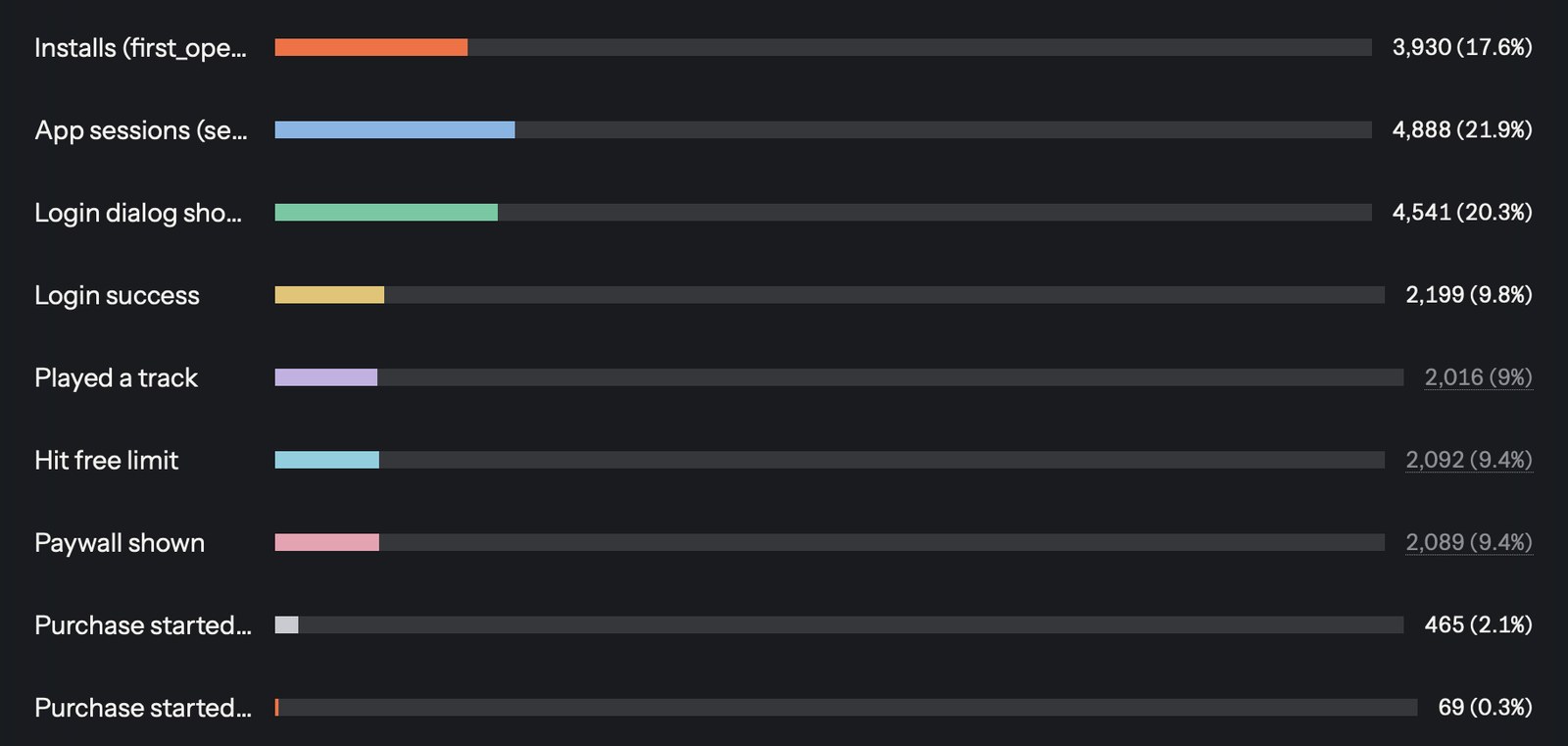
Here is a real example. One of our clients asked Bonnie one question: show our conversion funnel for the last 30 days, from install to login, first track played, paywall and purchase.
How did Bonnie bring the data together?
Bonnie pulled from the two connected sources that hold the answer and read them side by side:
| Connector | What Bonnie took from it |
|---|---|
| Firebase Analytics, via its BigQuery export | Every step of the funnel: event counts and unique users, from install to purchase |
| RevenueCat | The money: revenue, monthly recurring revenue (MRR) and active subscriptions |
What did Bonnie find?
Bonnie's answer covered behaviour and revenue together:
- Login was the biggest leak by number of people. 4,541 users saw the login screen and 2,199 completed it: about 52% left before hearing a single track.
- The paywall was overexposed. Bonnie counted both views and people: 10,304 views across 2,089 users, about five each in a month, with 61% dismissed. A count of users alone would have hidden that.
- Purchase completion had the worst rate. 743 purchase attempts became 48 completed purchases (6.5%). The discounted paywall completed 18.7% of the purchases started on it, against 5.1% on the default.
- Install to paid came out at 1.2%: 48 purchases against 3,930 installs.
- The business behind the funnel: $1,947.41 in revenue over the 30 days, $1,075 in MRR and 292 active subscriptions.
The window covered all users, not only new installs, which is why more people saw the login screen than installed in the period.
It is also the two-lens rule from earlier in practice. By absolute loss, login is the leak: 2,342 people dropped there. By rate, purchase completion is: 93% of purchase attempts didn't complete.
What would you have missed asking Firebase alone?
Firebase on its own would have given you the funnel and the drop-offs. It would not have told you what those drop-offs mean for the business:
- It counted 48 purchases. It couldn't see the 292 active subscriptions or the $1,075 in MRR behind them, because most of those subscribers signed up before this month and keep paying.
- It showed percentages, not stakes. With revenue in the same answer, a 52% login drop and a 93% checkout failure stop being statistics and become revenue leaks you can weigh against each other.
- And the reverse holds too. RevenueCat alone would show the money but never the login screen or the dismissed paywall, so you would see the revenue without knowing where it was being lost.
Asked separately, each tool answers half the question. Bonnie reads every relevant source together and gives you a holistic answer: where people leave, how much it matters, and which fix to try first.
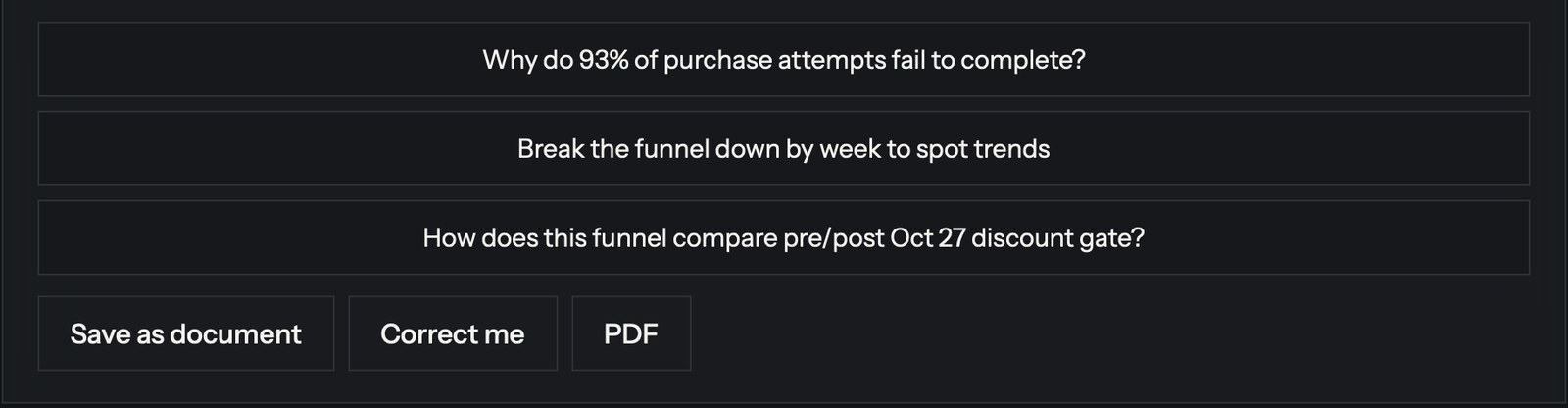
In chat, Bonnie shows the result as a funnel chart, with its read on the biggest leaks and the next questions worth asking: why 93% of purchase attempts don't complete, how the funnel moves week by week, and how it changed before and after a discount was introduced.
What else do people ask about conversion funnels?
What is a conversion funnel in simple terms?
A conversion funnel is the path from first awareness of your product to a key action, such as a signup or a purchase. It can mean the marketing stages (TOFU, MOFU, BOFU) or, in funnel analysis, a defined sequence of events counted in order inside a time window.
Marketing funnel vs sales funnel: what's the difference?
They are often used as the same idea: a staged path from awareness to purchase. When teams do separate them, the marketing funnel brings people in, and the sales funnel turns them into first-time and repeat buyers. For app founders, it is usually more useful to separate the stage model from the event sequence you measure.
What do TOFU, MOFU, and BOFU mean?
They mean top, middle and bottom of funnel: awareness, consideration and decision. TOFU's job is to get attention, MOFU's is to help people reach first value, and BOFU's is to turn ready buyers into customers with as little friction as possible.
What is funnel analysis?
Funnel analysis measures how many users complete a known sequence of steps, and where they drop off. It is not a path analysis (which discovers routes you have not defined) and it is not a cohort analysis (which tracks whether a group comes back over time).
Can Bonnie AI show where my funnel drops off?
Yes. Ask about a conversion path in chat and Bonnie builds the funnel from your connected sources: your analytics data for each step, and your revenue data for what each step is worth. It shows the result as a funnel chart and calls out the biggest leaks.
Next step
Write down your TOFU, MOFU and BOFU steps as events you can actually count, then ask about that path in one place at bonnieos.com. For setup, see How to Set Up Bonnie Ai.
Next read How to Convert Free Users to Paid: A Guide for App Founders